Microbiology Basics
Bacteria
Bacteria are microscopic living organisms, usually one-celled, that can be found everywhere. A few types can be dangerous – such as when they cause infection – but most are completely harmless or beneficial. Examples are the production of yogurt, cheese or salami. Microbes also produce beer and wine but that’s yeast; it’s still a single-celled organism but from a different branch of the evolutionary tree.
Enzymes
Enzymes are biological catalysts – catalysts make chemical reactions happen faster but in the case of enzymes they’re far more complex than anything chemists use. Enzymes do all the heavy lifting in all biological processes. They are complex proteins and each one catalyses a very specific reaction – and does it extremely well. Which isn’t surprising: they’ve had 3.8 billion years of evolutionary refinement behind them.
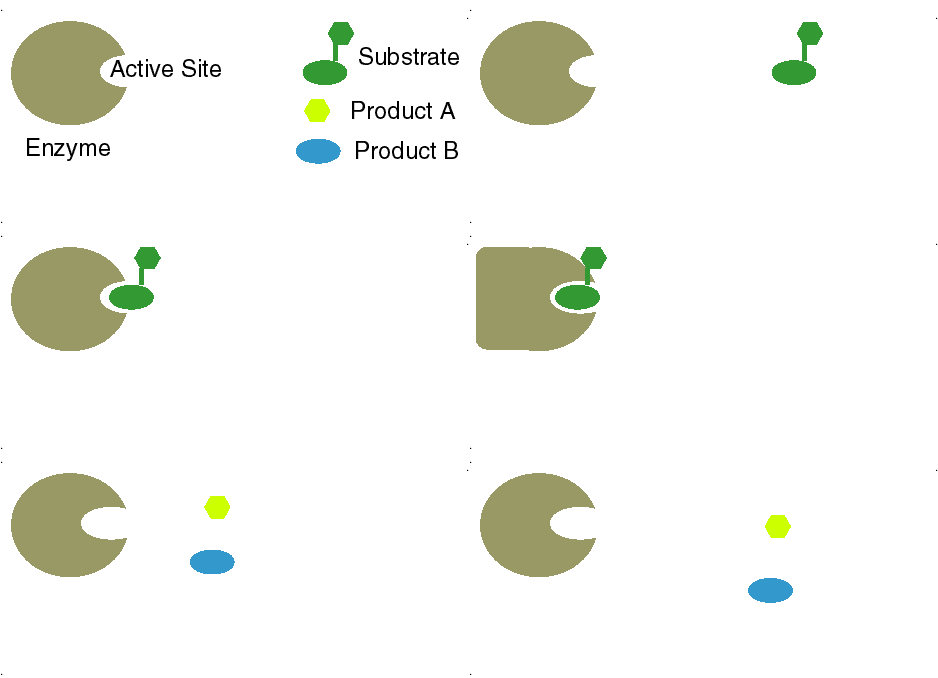
In our products we put them to work by breaking apart large, complex compounds (substrates) into smaller, more readily absorbed nutrients that the bacteria can absorb. Each enzyme is designed to unlock and break down a specific food source.
The Link…
Bacteria produce enzymes to digest food around them. They don’t have a digestive tract like we do – they’re only a single cell, after all, so they need to digest their food externally into molecules small enough to pass across their cell membrane.
The clever bit is they will produce the correct suite of enzymes to digest whatever is around them. We just need to find the right bacteria that are best suited to a particular task. Think of them as minute factories producing the correct natural enzymes to digest whatever is around them, be it starch on a food factory floor or fats, oils and greases in a drain or sewer.
Enzymes produced by the friendly bacteria in our products include:
The ability of bacteria to produce the precise enzymes needed for degradation has been honed over billions of years of evolution so it’s hardly surprising they’re so much more effective than industrial chemicals at many tasks.
Try this…
You can try this test to see – well, taste – enzymes at work. Take a piece of cream cracker and start chewing. Don’t swallow. Cream crackers taste pretty bland because they’re mostly starch. Starch is a long molecule made up of lots of sugar molecules (maltose and glucose) joined end-to-end.
As you chew it will start to taste sweeter. And sweeter. This is because of an enzyme called ptyalin (or salivary amylase) in your saliva which is breaking down the starch into its constituent sugars, hence the increasing sweetness.