Grease Trap Physics
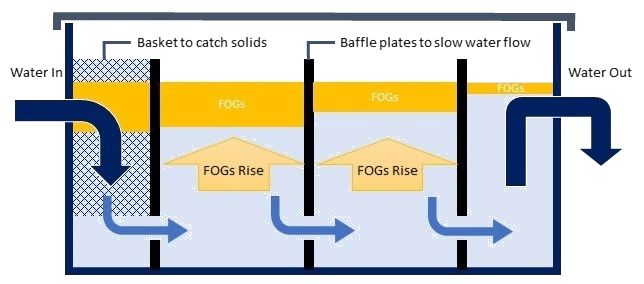
A greasetrap (or gravity grease interceptor) is quite simple in design. It is a metal or plastic box that is usually found under a sink in the kitchen, or underground either inside or outside the building.
Grease traps have a series of chambers to slow down waste water to allow fats, oils and greases to rise to the surface – because oil is lighter than water and so floats on it.
| Substance | Specific Gravity |
|---|---|
| Butter | 0.87 |
| Lard | 0.88 |
| Olive Oil | 0.91 |
| Water | 1.00 |
| Glycerine | 1.26 |
These captured FOGs need to be removed periodically (at least weekly as a rule) and taken away for disposal by a Licenced Waste Contractor. You can’t throw away FOGs in the general waste. It’s against the law.
The problem is greastraps need to be of sufficient size for the volume going through them – there is a European and British Standard to calculate this – or they get clogged with FOGs. If this happens they are rendered ineffective and the FOGs escape to the sewer – and you risk blockages and fines.
Grease poured into a still water will rise very quickly to the surface based on the size of the globules formed, their specific gravity, their viscosity and the temperature of the grease and water. The rise rates of the bubbles is predicted by Stokes Law. But the difference between a static body of water and a grease interceptor is that the water in the grease trap is not static. It flows. This is why the effectiveness of grease interception is affected by the amount of detergent, the flow rate and the temperature.
Questions? We can audit your FOG management with our free, no obligation survey and our Bio Drain Management system might help save you money and avoid blockages and fines.